
Let’s be honest: applying for a Schengen visa as an Indian passport holder can feel intimidating.
We don’t enjoy the same visa privileges as travelers from many Western countries, and the application process often involves a mountain of paperwork, financial proofs, travel bookings, insurance documents, and enough bureaucracy to make anyone nervous. At times, it can genuinely feel easier to get a new birth certificate than to apply for a tourist visa.
But here’s the good news: getting a Schengen visa for Indians is far from impossible.
In fact, every year, thousands of Indians successfully obtain Schengen visas and travel across Europe. The key is understanding what visa officers are looking for and submitting a clear, honest, and well-prepared application.
I know many travelers choose to hire agents for peace of mind. There’s nothing wrong with that. But based on my own experience, it’s absolutely possible to apply for a Schengen visa yourself and get approved without paying hefty agency fees.
In this guide, I’ll walk you through the exact process I followed, the mistakes to avoid, the documents you’ll need, and the lessons I learned while applying for my own Schengen visa. If I could get approved despite having a less-than-perfect profile on paper, chances are you can too.
Why Trust This Guide?
Unlike many visa articles written by agencies, this guide is based on my own experience applying for a Schengen visa as an Indian passport holder. At the time of my application, I was self-employed, had limited declared income, and planned a long backpacking trip across Europe. Despite what looked like a challenging profile on paper, my application was approved without an interview.
I’ve kept this guide updated to help fellow Indian travelers understand the process and avoid common mistakes.
I’ve always preferred handling my visa applications independently, which is why I originally put together this detailed Schengen visa guide. However, I also understand that not everyone has the time or confidence to deal with paperwork, appointments, and document verification on their own. If you’d rather have professional assistance, I’ve partnered with Visa365, a visa service I’ve personally reviewed for my readers. They can help simplify the application process and, as a bonus, you’ll get a discounted price when you apply through my affiliate link. Click here to visit my page on Visa365 website.
Can Indians Easily Get A Schengen Visa?
Yes, Indians can absolutely get a Schengen visa, provided they submit a genuine and well-documented application. And honestly speaking, you can very well apply it yourself. I also considered applying for my visa from an agency before going through the process of applying for a Schengen visa myself. But as I pondered upon the idea and calculated the prospects, I realized that it would be a lost deal, especially because I was on a limited budget. I mean we anyway pay a fee to VFS? They only act as the visa application center for Schengen countries. While they help with procedural questions, they do not influence visa decisions or provide advice beyond the embassy’s published guidelines.
So if you’re planning to apply for a Schengen visa in India, and by yourself, this guide will help you.
Right from what the documents for a Schengen visa to how good your chances are for a successful application, I will answer all your answers in this blog.
Also, check these Schengen visa rejection reasons before you continue reading.
Now, before I say anything, let me give you a picture of how grim my application looked when I applied for my first-ever short-term, single-entry Schengen tourist visa in India…
I was self-employed for the past 2 years, with almost no source of income. Though I filed income tax, every year, my income was always less than taxable. I had no employer recommendation letter to provide with my application either. On top of all that, I chose a 2-month travel period – which, more or less, raised doubts about my original intention of travelling.
“How can a person with no financial support travel across Europe for months,” I’m sure the Visa officer might have asked this question.
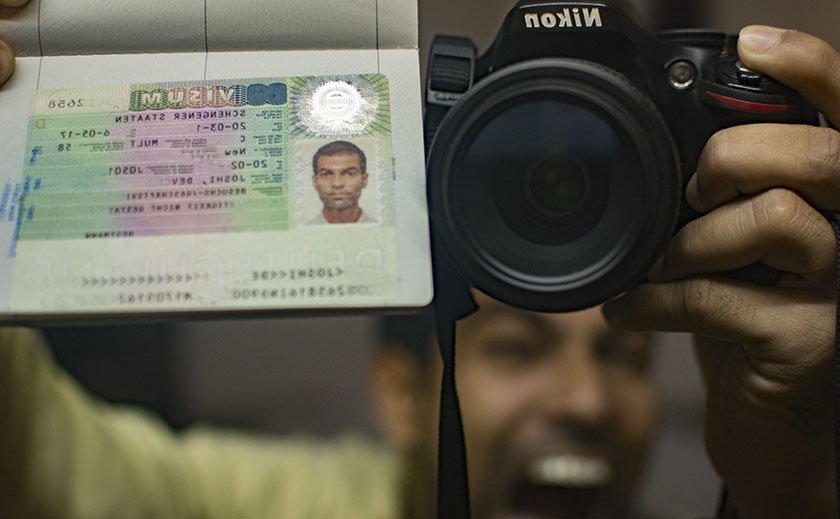
But as I submitted my Schengen visa in India, there were no questions asked. I was never invited to an interview. My passport was delivered to me in under 8 days from the date of submission. A beautiful stamp on my passport now says ‘valid for SCHENGENER STAATEN’! I like how German sounds!
Takeaway:
- If you’re already working and have a decent regular income, there’s no need to be scared. Because if a person with no employment history for years can get it, why can’t you?
Also Read: How To Plan A Europe Trip From India
Schengen Visa Requirements For Indians
Indian citizens need a valid passport, completed visa application form, travel insurance, proof of accommodation, flight reservations, proof of sufficient funds, and a cover letter explaining their travel plans. Applications are usually submitted through VFS Global and processed by the respective Schengen country’s embassy or consulate.
- A valid passport with at least two blank pages
- Completed Schengen visa application form
- Passport-size photographs
- Confirmed travel itinerary
- Flight reservations
- Hotel bookings
- Travel insurance with minimum €30,000 coverage
- Bank statements
- Income tax returns (if applicable)
- Employment proof or business documents
- Cover letter explaining your trip
Step 1: Decide Which Schengen Country To Apply Through
My original plan was to backpack across 8 countries for 58 days. Though I was starting from Switzerland, I was spending most of my time in Germany (over 15 days) and this made me eligible to apply for my Schengen Visa for Indians at either Switzerland’s or Germany’s embassy in India.
[I hope you know the rule, which says: you are eligible to apply for the Schengen Visa at the respective country’s embassy where you will be 1) arriving first, or 2) spending most the days during your travel in Europe]
Now, the reason I chose Germany and not Switzerland is that the Swiss embassy has a bad reputation, as compared to that of Germany. Though the German embassy is not generous either, it was better than that of Switzerland. You can Google for the list of countries that have more visa rejection rates.
Takeaway:
- Google and find out which countries have higher visa rejection rates.
- While visa approval rates can vary between countries, the most important rule is to apply through the country where you will spend the most time, or your first point of entry if your stay is evenly split. Consistency and genuine travel plans matter more than trying to “game” the system..
Step 2: Complete The Visa Application Form
Once you’ve decided which embassy you’re going to apply it from – whether it is a France visa for Indians or a German tourist Visa – the next step is completing your application and submitting relevant documents.
Though different countries slightly vary in the rules, the supporting travel documents for the visa application remain more or less the same. And they are… your bank statements, a return flight ticket for a visa, confirmed hotel booking, all inside-Europe travel bookings, and travel insurance with a minimum coverage of 30,000 euros (check this travel Insurance for Indians blog for suggestions where I have compared different insurances).
Filling your visa Schengen visa in India is simple, and takes no more than a couple of hours. If you’ve any doubts, you can also always contact the VFS office but as I said, they’re a cheap middleman and know nothing more than the guidelines already mentioned on a respective country’s website. And I’m saying that out of my personal experience.
So, if you have major doubts about your Schengen visa for Indians application, it’s advised to directly write to the country’s embassy in India rather than contacting the VFS.
Takeaway:
- Avoid contacting VFS, they know nothing more than you do.
Step 3: Prepare The Required Documents
Convincing the Visa officer that your sole intention is to travel, and travel only is crucial. This is done by showing more than enough funds in your bank account (explained later in the article WHY and HOW!) and providing other travel documents, including a return flight ticket, all confirmed hotel bookings, all inside-Europe travel bookings, and travel insurance.
In my case, I provided proof of enough funds in my account… a 100 percent refundable, but confirmed flight ticket (so that I can later cancel it without losing any money) all pre-booked hotels (with no reservation charges and free cancellation, using booking.com) and the mandatory travel insurance (from Reliance General Insurance, which comes with free cancellation, if the visa is rejected).
The only required document(s) I didn’t provide was my pre-booked transportation inside Europe – and for that, I clearly mentioned in my STATEMENT OF PURPOSE AND TRAVEL ITINERARY that I didn’t provide those because I might be hitchhiking and booking last-minute bus/flight tickets to save costs, and it worked just right.
Step 4: Write A Strong Cover Letter
For those who don’t know, a Statement of Purpose (with your entire travel itinerary) is a personal cover letter, addressed to the visa officer, which talks about your original intention to travel, the places you are going to travel, and how long. You need to provide a statement of purpose or a cover letter, for almost all visas you apply for – whether a US visa or a Japan visa or an Australia tourist visa.
There’s no harm in going subjective with your thoughts, and I think it only helps you better if you do. Provide as many details as you can, and convince the visa office. I wrote a 3-page long cover letter.
It is moreover a good idea to provide a route map with all your locations and dates of travel. And I think it’s because of the detailed, and very personal statement of purpose, that the officer felt assured that my sole intention was traveling.
Remember whether you travel cheaper (as was the case with me) or take expensive tours if your application looks genuine to the Visa officer you will be granted permission. Visa officers appreciated clean applications for Schengen visas for Indians.
Takeaway:
- Provide a very personal and clearly detailed itinerary.
- Never lie about anything in your cover letter. Honesty does work in your favour.
- Book hotels from Booking.com, with no reservation charges and free cancellations.
- Always book a refundable flight ticket.
Step 5: Show Proof Of Funds
Unlike hotel reservations and pre-booked transportation, which can be smartly escaped from, here you don’t get much flexibility. You have to have the minimum required money stocked up in your bank, so the visa officer feels confident about your financial situation.
When I applied through Germany, the expected daily budget requirement was roughly €65 per day. However, these requirements can change over time and may vary between Schengen countries, so always verify the latest figures with the embassy or visa application center before submitting your application.
I moreover think that there isn’t a minimum time duration since you are required to have the money in your account. In my case, I had the maintained balance for less than 3 weeks, and it worked just right.
Schengen Visa Fees For Indians (2026)
One of the most common questions Indian travelers ask is: How much does a Schengen visa cost?
As of 2026, the standard Schengen visa fee for Indian applicants is €90 for adults, while children between 6 and 11 years generally pay a reduced fee of €45. Children below the age of 6 are usually exempt from visa fees. In addition to the visa fee, applicants must also pay a service charge to the visa application center (such as VFS Global), along with any optional services like courier delivery, SMS updates, or premium lounge access.
When I applied for my first Schengen visa, the fees were considerably lower than they are today. Regardless of the amount, remember that visa fees are generally non-refundable, even if your application is rejected. This is why submitting a complete and well-prepared application is so important.
If you’re applying independently, always check the latest fee structure on the embassy or visa application center website before booking your appointment, as fees can change over time.
Schengen Visa Processing Time
The official processing time for a Schengen visa is generally up to 15 calendar days from the date your application is submitted. However, during peak travel seasons such as summer holidays or Christmas, processing may take longer. In certain cases where additional verification is required, applications can take 30 to 45 days or even longer.
In my case, I received my passport back in less than eight days, which honestly surprised me given how nervous I was about my application. But every application is different, and past results should never be taken as a guarantee.
My recommendation is to apply at least 4 to 6 weeks before your intended departure date, and preferably even earlier if you’re traveling during a busy season. Most Schengen countries allow applications to be submitted up to six months before travel, which gives you plenty of buffer time in case appointments become difficult to find.
A complete application with all required documents is one of the best ways to avoid unnecessary delays.
Common Reasons For Schengen Visa Rejection
Although thousands of Indians successfully receive Schengen visas every year, rejections do happen. The good news is that most refusals occur because of avoidable mistakes rather than because the applicant is Indian or lacks a perfect profile.
Some of the most common reasons for Schengen visa rejection include:
1. Insufficient Proof of Funds
Visa officers need to be confident that you can comfortably afford your trip. Large last-minute deposits without explanation can raise concerns. Your bank statements should show stable financial activity that matches your declared income.
2. Incomplete or Inconsistent Documentation
Missing hotel bookings, unclear travel plans, discrepancies between documents, or errors in the application form are among the most common reasons for refusal.
3. Weak Travel Itinerary
A vague itinerary can make it difficult for the visa officer to understand your purpose of travel. This is why I strongly recommend preparing a detailed day-by-day travel plan and including it with your cover letter.
4. Lack of Strong Ties to India
Visa officers want to see evidence that you intend to return to India after your trip. Employment, business ownership, family responsibilities, property ownership, or ongoing studies can all help demonstrate strong ties to your home country.
5. Inadequate Travel Insurance
Travel insurance is mandatory for Schengen visa applications and must meet the minimum coverage requirements prescribed by Schengen regulations. Applications may face issues if the insurance policy does not comply with those requirements.
My Personal Advice
When I applied for my first Schengen visa, I was self-employed, had modest declared income, and planned a long backpacking trip across Europe. On paper, my profile wasn’t ideal. What helped was presenting a genuine itinerary, honest documentation, sufficient funds, and a detailed cover letter explaining exactly why I wanted to travel.
The biggest mistake applicants make is trying to make their application look impressive. The best applications are usually the ones that look honest, logical, and easy for a visa officer to understand.
And now, some of the most frequently asked questions…
How much bank balance is required for a Schengen visa from India?
The required amount depends on the country you’re applying through and the duration of your trip. As a general rule, you should be able to demonstrate sufficient funds to cover accommodation, transportation, food, and other travel expenses throughout your stay.
Is travel insurance mandatory for a Schengen visa?
Yes. Travel insurance is mandatory and must provide a minimum coverage of €30,000 for medical emergencies and repatriation.
How long does Schengen visa processing take in India?
Most applications are processed within 15 calendar days, though it can take longer during peak travel seasons.
Can I apply for a Schengen visa without a travel agent?
Absolutely. Thousands of Indian travelers successfully apply on their own every year. If you carefully follow embassy guidelines and submit complete documents, using an agent is optional.
Which country should I apply through?
Apply through the country where you will spend the most time. If your stay is equally divided, apply through the country where you first enter the Schengen Area.
I feel that applying for a Schengen visa in India by yourself is simple, and easier and gives you much flexibility to create an itinerary the way you want. I paid just a little over 6000 Rupees including my visa fee, VFS charges and the passport courier service.
The accommodation I booked and the flight tickets I purchased – were also cheaper, at least cheaper than what any travel agent would have possibly provided me with!
If you found this article on the Schengen Visa for Indians useful, you may also find my other related articles equally useful. Check Thailand visa on-arrival tips and Cambodia tourist visa tips.
If you have a question or would like to connect, please find me on Instagram. You can also follow my YouTube channel for video updates.